Mini-Z ESC Tuning: Punch, Brake, Drag Brake
What ESC tuning parameters actually do on track — punch control, brake strength, and drag brake settings explained practically for Mini-Z RWD and AWD platforms.
MR-03 · MR-04 · MA-020
The ESC (electronic speed controller) is one of the most misunderstood tuning levers on a Mini-Z. Most people set it up once with the default parameters and never touch it again. That’s leaving real performance on the table.
Three settings define how your car accelerates and decelerates: punch, brake strength, and drag brake. Adjust these wrong and the car snaps, washes out, or feels disconnected. Get them right and the car drives on rails.
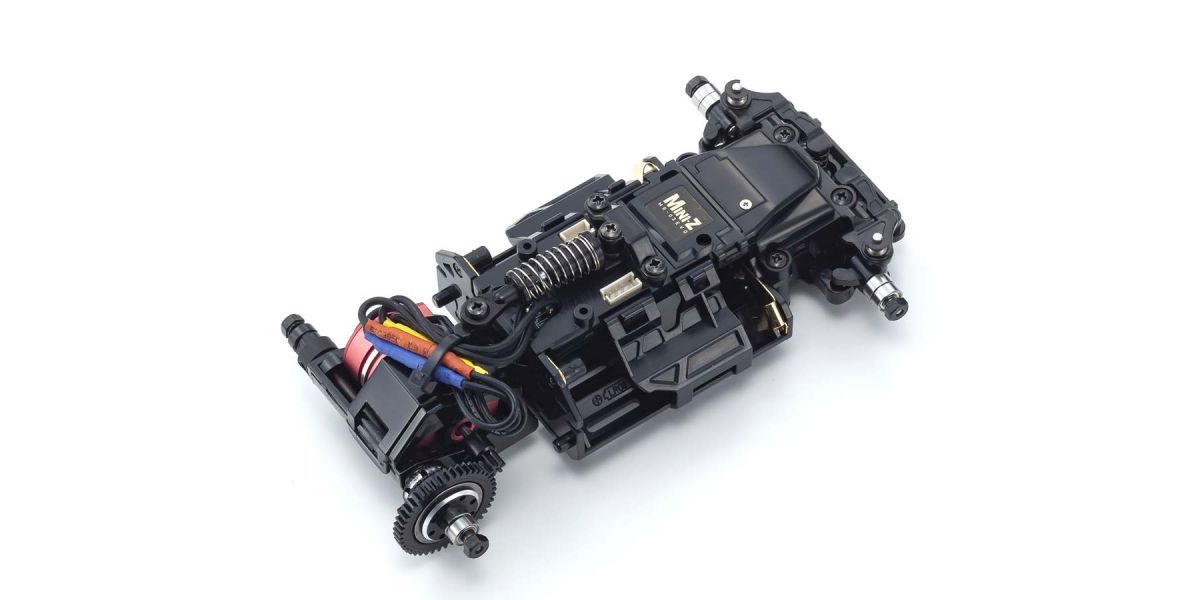
What the ESC Actually Controls
On a Mini-Z, the ESC interprets your trigger input and converts it into current delivered to the motor. The parameters below don’t change how much total power is available — they change how fast that power arrives and how aggressively the motor resists wheel spin.
For brushless setups using a standalone ESC like the → Yeah Racing Brushless ESC for Mini-Z on Amazon, all three parameters are fully programmable via the transmitter or a programming card. Stock brushed ESCs on OEM receiver boards have limited adjustability — usually just a few steps — but the same principles apply. Not yet brushless? The Brushless Conversion guide covers the full system.
Punch Control
Punch is the rate at which the ESC ramps up from zero to full throttle. It’s not a power cap — it’s a delay curve.
- High punch: Motor torque arrives immediately when you squeeze the trigger. Fast, aggressive acceleration. On RWD, this means more wheelspin off the apex.
- Low punch: Motor ramps up gradually. The car squirts off the corner instead of snapping. More manageable, especially on carpet or RCP with worn tile.
On a dry, high-grip RCP track, moderate-to-high punch is usable because the tires can handle the torque. On a slicker surface — polished tile, old RCP, smooth concrete — drop punch by 1–2 steps before anything else. Wheelspin off corners on RWD isn’t a tire problem, it’s usually a punch problem.
AWD platforms like the MA-020 are more tolerant of high punch because power is distributed across all four wheels. Even so, overly aggressive punch causes the car to push wide on exit as the front and rear fight each other.
Brake Strength
Brake strength sets how hard the motor decelerates the car when you release the trigger or squeeze the brake channel.
- High brake strength: The car stops fast. Useful for tight technical layouts where you need to scrub speed immediately before a hairpin.
- Low brake strength: The car coasts longer. Better for flowing tracks with sweepers and long braking zones where trail-braking is part of the line.
Brake strength also affects corner entry on RWD. Too much brake on trail-in will lock the rear and snap the car around. Start conservative — around 30–40% of maximum — and only increase if you’re missing your marks on braking.
One practical test: find a straight on your track, run at full speed, and do a hard brake from the same reference point every time. If the rear steps out during braking, reduce strength. If the car dives past your mark, increase it.
Drag Brake
Drag brake is the background braking force that applies automatically when the trigger is in the neutral position — no active braking, no throttle. It simulates drivetrain friction and makes the car feel “connected” rather than free-wheeling.
- Zero drag brake: The car coasts completely when you lift. Smooth, predictable, but can feel loose on corner entry because the rear isn’t being stabilized by the drivetrain.
- High drag brake: The car decelerates steadily the moment you lift. Tightens the entry line, adds rotation, but can destabilize a RWD car on high-speed sweepers if set too aggressively.
Drag brake is where RWD and AWD setups diverge most. On an RWD platform like the MR-03 or MR-04, 10–20% drag brake is a useful starting point. It tightens corner entry without inducing snap oversteer. On AWD, you can run higher — up to 30–40% — because all four wheels contribute to slowing the car smoothly.
Where to Start
If you’re dialing in a new brushless setup:
- Punch: Start at 3 out of 10 (or the equivalent middle-low setting). Increase only after you’ve sorted the other two.
- Brake strength: 30–40% of maximum. Enough to modulate, not enough to snap.
- Drag brake: 10–15% on RWD, 20–30% on AWD.
Run a full heat with these settings and pay attention to two moments: throttle application at corner exit, and car behavior on lift-off at corner entry. Each tells you whether to move punch or drag brake.
Tuning Sequence
Change one setting at a time. ESC parameters interact with each other — and with your spring rate, T-plate flex, and gyro gain. If you adjust punch and brake simultaneously and the car improves, you won’t know what did the work.
Track conditions also shift settings. A fresh RCP roll-out has more grip than a pack-run tile after an hour of racing. It’s worth having a baseline card written down so you can reset quickly.
The ESC is not a set-and-forget component. It’s one of the fastest tuning changes you can make trackside — no tools, no teardown. Use it.
OEM drop-in gyro. Corrects snap oversteer on RWD platforms. Essentially mandatory above casual use.
Shop →Direct replacement for MZW405. Works with MHS, ASF, and EVO receiver boards. Adjustable gain.
Shop →For pairing with a separate brushless motor. Brushless-compatible, programmable timing and brake strength.
Shop →